a journal of...

A journal among friends...
art, words, home, people and places
Showing posts with label artists. Show all posts

Friday, August 28, 2020

The imaginary traveler


Here's what bothers me the most about these Covid-19 days, going on and on without resolution or salvation (or, in this city-state-country, sanity): the inability to grab a ride to the airport and head for somewhere interesting.  We have been holed up so long, keeping busy with the mundane work and make-work that fill the day, not to mention tiring, desperate negotiations of space when we do venture out for a bit of air.  Travel seems like a lost dream that haunts me.

It's not that I don't have plenty to do.  But these days Paris and Provence seem to have taken over the dream waves.  The romanticism of the place grows as farther I get from the possibility of return any time soon. I pick up articles and books on French life, fiction and non-, and download French movies, especially those with my favorite actors...Juliette Binoche, Patrick Bruel, Fannie Ardant, Catherine Deneuve, Sandrine Bonnaire, Gerard Depardieu.  I lean in, listening hard to their spoken French more than watching the translated words at the bottom of the screen, though I miss more than I catch.  In the air, French songs even Alexander will dance to.


On Prime, I found a teacher who laid out the verb faire (to make or do...the French think of them as the same verb) in idioms I could actually use, should I arrive on the Blvd. Raspail wanting to take a walk or do some shopping.  I've copied them down, each day memorizing another of the two-page list.  Tu fais la tete a moi?  Je le regard...


Pathetically, I leave my Paris guide book on the table so as a book or film flashes a scene at me, I can open the map and pinpoint it exactly, perhaps even remembering when I, too, walked over that very pont.  Yesterday, the latest issue of France Today tauted a neighborhood in the 19th arrondisement that I hadn't heard about, though apparently it's becoming trendy.  I made a note to find an apartment there for a month or so, somewhere close to the tiny streets of burgeoning art galleries and ateliers, convenient outdoor cafes, and small hidden prizes among les bistrots. I see Saint Chappelle is in easy walking distance for concerts.  Ah!  bon, there is an open-air market, where I can get everything I need, even if I leave on the next plane without bothering to take a suitcase.  

photo:  France Today

When the French decide I am responsible enough to resume visitation, I promise myself to be the first one off the Paris Star from London.  (Maybe I should fly to Heathrow now to be ready ...will they let me in?) 


 I promise to wear a mask everywhere and slide far enough away around crowds.  I will pick a morning when everyone is at a boule tournament to visit the Jacquemart-Andre and, though I love lunching in that elegant salon, will picnic all by myself in a quiet copse of that little garden attached to a little museum on a street I can't remember right now, except it was down the rue from the Carnavalet.


Is all this fantasy healthy, I wonder? And yet I can feel it in my bones, particularly today when a sort of wanderlust has sacked my energy.  Though I have kept the ordinary going...cooking market vegetables, tearing out and re-hemming a difficulty in what ought to be a simple child's quilt, making list upon list to do another day, watching Alexander learn with his virtual schoolmates...here is this blog post about Paris.  It could easily have been about Menerbe.


Outside my window, the leaves of the tulip poplar drop yellow, one by one.  I think of the plane trees along the boulevards about to do the same.  It's not a difficult leap to make, imagined or en realite'.


Saturday, November 5, 2016


Cathy and I invite you to our 
Open Studio
for Art, Tea and Treats
just in time for the Holidays!

November 12 and 19   *   10 - 4  

                           901 Roosevelt Drive, Chapel Hill
Come see what treasures you can find for Gifts
(and a little Self-Indulgence, too).


Philly, or the Way the Wind Blows

So, last week, my friend Denise and I took the train at the station half-way between our homes, and rode in style up to Philadelphia.  We stayed with friends Anne and Phil, most gracious, genial hosts, considering that we exceeded the Fish-and-Guests rule by at least one night.  Amtrak at its best is the vehicle I prefer going north, which I do at least five or six times a year, mostly for family reasons. The I-95 corridor is a horror; the eastern and western routes are more scenic and only a little slower, but still a tedious ride through craziness.  This time, the day was beautiful, Amtrak was almost on schedule, and the reason for going was pure pleasure.

Train trips for me are usually solitary events.  I bring my stash of books, sewing or knitting, correspondence to catch up on, etc.  I can get a lot of things done on a day trip by train, that is, after I spend the first hour or so gazing at the passing countryside, counting clotheslines and pastures, old towns the train passes through the center of, and cars and people stopped for our passage.  It's like meditation.

But this time I had a fellow traveler.  So, mostly Denise and I talked, and talked, and talked (snacking in between, both of us having come well provided).  There seemed a lot of catching up to do, but also a lot of planning about what to do in the City.  Denise (I guess she won't mind me saying so) has been thinking about moving there.  Her first visit to Philly last spring was what she called her "honeymoon" phase, enchanted enough to make it her own.  This trip, the post-honeymoon, was meant to explore it in more practical terms.  Staying with Anne and Phil helped enormously, because each morning we left out for neighborhoods unknown from a beautiful and very central part of town, and their help with sights/sites along the way was invaluable.  Phil, particularly, made sure we had a good history, familial, civic, and architectural.

What made the visit even more spectacular was the season.  There is nothing like windy, cool weather in a city of brick sidewalks, tall brownstones and short triplets with Hallowe'en pumpkins and spider webs on stoops, imposing marble and concrete facades with historical and mythical figures sculpted across facades and friezes (I think that's the right term), and modern glass towers,with five or six more of them going up.  As in Aruba, it was the architecture which told the story of the place best, at least to me.  Even on our way to what we believed would be a definite destination, we meandered around streets, circling and snaking to pass another monument, only one or two...or four...blocks beyond our way.

Philadelphia is a city of neighborhoods.  Each has its character, as neighborhoods do, each its charms and quirks.

House  
We traipsed up and down Chestnut and Walnut Streets, dropping into a paper store, a tea shop, an old book shop, and the path along the river, the wind ever our companion there.  We toured City Hall, the great Masonic Temple, the Terminal Market.  We wound through the Italian market to taste the once-a-year Betty Cheddar, the fabric warehouses for bargains (I now have new porch cushions and a beautiful piece of sea glass silk to join the other beauties I pick up along the way without immediate purpose).  We lost ourselves on sidestreets and peered curiously into intriguing alleyways.

Cheese
We admired the Free Library, its spacious airiness, but that was after we had perused the shelves at the Friends bookstore, coming out with even more books to carry home.  We stumbled on the Basilica, obviously recently restored, shining with gold and blue.  We loved searching out the murals, particularly a clever one behind a Sunoco station wall, and its tangent, which illustrated the church once standing there, as if reflected in the buildings' ghostly windows.  The city remembers its past.

Church gone but still present
Like neighbors, people talk, give directions cheerfully, offer advice.  Mid-morning on our first day, we eyed enviously a man at a small market holding a cup of steaming coffee, and asked where he got it.  He told us, and pointed the way.  Then, he turned around and came back to offer a second opinion.  "What kind of coffee do you want?  OK or really good?"  The second, we both assured him.  "Oh, then, instead, go to that place across the street."  And he was right.

Person after person, most of them natives, said to Denise,  "Oh, this is a great city!  You'd like it here."  Cities, of course, change with the generations who come and go, with re-purpose and re-design.  One coffee-shop fellow shrugged wryly when we asked about his neighborhood, where he grew up and still lived.  "You wouldn't have found this place here ten years ago," he said.

Spreading the news in the Marketplace
We walked and walked, six and seven miles a day.  It's easy to do, always something to see and all those parks, from Rittenhouse Square, near our stay, to Washington, Fitler, and Logan Squares, the latter of which opens the way to the elegant, peaceful Barnes Museum park.  There were smaller children's neighborhood parks nearly everywhere we ventured (with coffee shops nearby), so it was easy to consider the usefulness of each area not only for visiting but for living. There were grassy parks, waterside parks, orderly paved-and-landscaped parks, parks for nannies and babies, parks where police in closed gazebos watched, parks where runners trained, where pedestrian commuters plod to work across the river.  There were entertainment parks (we didn't bother with those), ballparks (or those), pocket parks between tall buildings where readers ate lunch in peace.  

Rittenhouse Square
At the end of each day, we were tired, but not undone, and full of adventures to relate to our indulgent hosts.  "You're making me want to visit my own city again," Anne laughed.

Obviously in Denise I had a companion worthy of the voyage, and despite my wanderlust was glad to have her mission as our overall goal.  We weren't, she reminded me, tourists as much as travelers.

By our last days, we had come to two cultural icons with real Philadelphia stories:  the Rosenbach Museum and Library, and the Barnes.

What to say about them?  Neither were experiences language translates well, though the Rosenbach is full of words--a grand (I use that word literally) collection of books by a man who gathered, from childhood, ancient folios to dog-eared paperbacks, classics to commonplace.  Being housed in his home, those rooms full of creaking leather and closely packed titles still seem a personal library.  They are easy to find if one is browsing, well-organized if one is researching.  And yet there are quirks, too, the idiosyncratic part of the collector, I suspect.


The Marianne Moore room, a replica of her own parlor (the Rosenbach owns her papers), was unfortunately closed, for some "issue", our guide was vague. (A woman more at home with administration, she seemed to know the books by hearsay rather than reading; I wonder what the Rosenbachs would have said about that.)  But she knew her Rosenbach history, as did our hosts, so we learned their story as well as that of the collection itself.  On Bloomsday each year, James Joyce's Ulysses is trotted out and read by volunteers; wouldn't that be fun?  Only half tongue-in-cheek, I volunteered for next year.

As for another eccentric collection, Dr. Albert C. Barnes's carefully studied, impeccable and foresighted hobby has afforded us a vision of impressionist and post-modern art that boggles (I'm using that word pretty literally, too, and not unlike the dice game) the eyes.  Both scientist and art lover, his friendship with the Philadelphia artist William Glackens and his pharmaceutical studies in Germany gave him superb vantage points for acquiring art that matters.  Ironically, his growing (and celebrated) antagonism with the Philadelphia Art Societies means that while the works were at first too closely guarded, and then after his death badly kept, it now resides in a building that showers light, calm, and dignity--not to mention access to  the public--to his life's affinity.  Even if it meant crowding 25 to 40 pictures into each small exhibit room built to the sizes of the Barnes house display rooms (the main halls and downstairs library and sitting room are enormous in comparison).  Even if it meant breaking his will.  Which is not an easy thing for me to say without shuddering.

All right, enough lecture.  Here's what I saw, which is the only way to describe a venture into the Barnes. [As photographing wasn't allowed, at risk of copyright infraction (I checked, and I think these are public record), I show a few images, to indicate the varied scope of those rooms.]


The Barnes is modern, spare, and both over-and understated, fitting into the landscape like a fortress and a temple, depending on which way you approach.  It is raining lightly and around the corner from the nearly hidden ticket booth, around a shower of green ground cover and high grasses, a long, low, perfectly rectangular pond of dark gray stones, leading to the entrance, shivers a little.  Small, discreet signs point to the high stone facade and glass doors, both equally squared and angled.  Around (another long) bank of ticket takers, the reception hall opens.  In the near corner is a round table set with event-oriented decor; in front of it, eyeing the settings, perhaps for a wedding, are a mother and daughter and a persuading staff person.  But that's only a miniscule part of the room.  At first it seems as if we will never find the way to the paintings across this cloud-ceilinged immensity, but there is a cluster of staff at a center door, and we follow them in.  And lo, the first room.


Each room is numbered, so the comb-like nests can be traversed without confusion.  Otherwise, the paintings themselves draw us into confusion, as our eyes slip haphazardly from one to the other, hardly able to take in what's there.  Only a few large works own their own space.


What's fun about these exhibits, particularly in view of the crowding, is the enticement they offer to make a game of viewing them.  There is no particular order apparent to the way they are placed.  Not, as brochures and room-monitors told us, by chronology or painter or period or country, or subject or theme or anything.  They are simply hung as Barnes hung them, the way he saw them relating to one another.  That's Game One:  what did he have in mind?  Denise and I began to notice patterns in placement, color, even depth, not always repeated but often enough.  More interesting were sometimes wildly diverse companions on a wall which spun a witty tale of  human folly or perversity.


No, we didn't tire of the Cezannes and Matisses, and found artists we hadn't known to appreciate.  We spent four hours that day, but for the sake of those narratives, I would visit again, because I am convinced that Barnes' eye saw more than design or value in his collection.  I think he was a storyteller, too, using his art as his tablet.

Interestingly, the question of beauty...what makes art beautiful?...had come up at breakfast that morning, after Anne's evening group, reading the classical philosophers, had rather hotly debated the issue.  It was no surprise to find it echoing throughout our stroll through the Barnes.  I remembered Athena's judgment of Arachnea:  no matter the expert skill, there is no beauty without lending the subject its dignity.  So much can be answered that way.

I made up Game Two just to get through the enormity of so much imposing (and some not so imposing) art at once.  As a way of centering myself, in each room, I'd look around before I left and figure out which one I would take home.  Don't laugh!  It was, in fact, harder than you think. Appreciating all those famous pieces is one thing.  Willing to make one at home on your own walls is another.  I rarely came away from a room having to decide between two.  Mostly I knew the one.
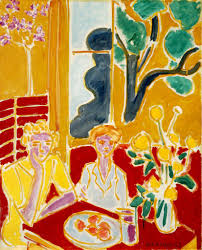
     This one, for instance.

Walking through the Barnes--and the Rosenbach, as well--out of the weather's wind but into the breath of its creator's wonderland reminded me of the way we personalize art, the way we take to heart one book, or one painting, and then another and another, and fit them snugly into our lives.  Whatever our reason for acquiring, keeping, holding them dear, they become us in a way.  Some of us are lucky enough to share that with the world.  I thank Philadelphia for offering us that.


Wednesday, November 2, 2016

Philly, or Travels against the Wind


A few weeks ago, rounding the corner of Hurricane Matthew, I flew to Aruba with the children for their family vacation.  I'd held as my beacon for a long time a trip to Paris I've been saving up for in early spring, so at first, when they asked me, I waffled a bit, thinking about the lure of cafes and walks through elegant parks on my own time.  I'm not good with resorts ("That's a great first line for a story," Jill McCorkle joked when I told her about it). But I did want to spend relaxing time with them, and I'd never been anywhere in the Caribbean.

So off we went, and the pilot, though he'd warned us apologetically of a bumpy trip, made in fact a pretty smooth affair of it, gliding around the storm, costing us barely an hour and saving the journey from Miami to Orangestad.

 Aruba is a small island, only about 20 miles long and barely 6 miles across, nearer to Venezuela than anywhere else, but it was a Dutch possession for so long (with farther back Spanish influences and even farther back Amer-Indian) that one's impressions of it are shaped by the fantastic architecture, smooth-faced low buildings with the curled accents of European inhabitants, but in bright island colors.  At least, those are what built the original towns--the capitol's back streets, Santa Cruz, Savaneta, San Nicolas among them.  You could hear its roots tangled in its language.

On the other hand, the resort area of Palm Beach, where we stayed, is another story, pretty much indistinguishable from those photos cluttering websites and print ads of beach resorts everywhere...high white hotels with uniformed guards (the more expensive the place, the more they frowned at passing intruders), miles of blue lounge chairs facing the sea, low pools whose central gathering place is the floating bar.  And on the streets behind them, fancy shopping of the kind found anywhere from Fifth Avenue to Nice to the great mall at Tel Aviv.

Because of Matthew, the famous white sands were, when we first arrived, gray with rotting seagrass and pieces of sponge and coral, and the equally famous seas, known for their clear blue-green jewel tones, were dulled (Aruba isn't hit with hurricanes directly, but does receive the resulting ocean debris nonetheless).  Hotel staff spent all day trying to rake and cart away the mess, but it took them most of the week, and only on the last day were we able to enjoy its return to the advertised normal.  On that day, we floated and dived under the morning's bright sun, watching the fish school in and out around our legs. Ah.


What I wanted most to do every day was walk on the beach, but debris and the jutting hotels made that difficult to do for more than half a mile or so.  Instead, we built rock forts and walls with Alexander, lounged around the pool while he splashed with other children from everywhere (resorts are wonderful for the younger set), and in the hot afternoons, took drives to the outer limits of the island.


For me, those drives were the highlight of the trip to Aruba.  We saw the brochure-touted landmarks, yes--brilliant white lighthouse, tiny precious chapel, the beautifully, perfectly restored historic museum and the Fort downtown where there was an intriguing textiles exhibit, both historic and contemporary.


But we also saw the everyday island.  That's what interests me about a place.
Along the roads, there were coves that dipped protectively in and out of sparsely inhabited shores, cottages with porches where people gathered after work, larger estates, once the neighborhoods of the all-but-defunct oil industry, now barred and mostly for sale, the corner bodegas and grocers, dogs and children roaming street to street, a neighborhood fair where green-iced homemade cakes and Dutch fried breads competed for tasters and music filled each street-end.  Out even farther, in the desert that covers a good deal of the island, fields of tall cactus, thick as forests in some places, formed mileposts.


Aruba's best art is as much her artless countryside as it is her artists' native expressions.  I was inspired by both.


One afternoon, we drove out up the narrowest of roads, bumped every few feet by rocky drainage spurs, and found ourselves at the Quadirikiri caves, black and pitted from the spray of the nearby sea, storm-spurred, crashing against the bulwark of cliffs.  We walked down toward an abandoned house wide open to the elements (it could be yours for a single year's underpaid academic salary, and then two more years' overpaid salary to make it habitable again) and found there the remnants of two gardens, a flowing creek pooling under a canopy of graceful limbs, and, inside, the once beautiful floors still tiled coolly against the heat.  I imagine a life there, at the edge of the world, just the right size house, nearly self-sufficient (though supplies would be a long long trek, or helicopter delivery, each month), the bones of the desert white in the moonlight, the hardscrabble ground blinding day, and this calm outpost the shelter of the mind.


Travel, even the kind one waffles over, brings such surprises, such visions, and, eventually, such art.  Like houses, being shown the parlor isn't seeing what's really a home. I think of the stereotype of the place I imagined, and how, though some of my reasons for it turned out to be true, there is always a reality worth realizing, a life beneath the mask tourism paints on a country.


And by the way, if you are puzzling over the title of this piece, you'll have to wait until next time to realize that one.  When I started out, I meant to write my more recent trip last week to the City of Brotherly Love, using Aruba as only a short preface, but this is what writing is like, isn't it?  You never know where it's going to take you. So consider this Voyage I, and Voyage II (the Real Philly) to come walking in just after it.  And walk we did.

Wednesday, September 14, 2016

Cinnamon

Tuesday, September 06, 2016

Though the temperature reads almost 90 this afternoon, there’s a real difference in the air that smells like Fall.  This morning’s early walk around my neighborhood circles was cool and light, the sun just coming up above the rooflines.  And I’ve still got the doors open with a breeze floating through now and then.
Cathy Burnham, copper bracelet

In the studio, at work painting some cards for Holiday with Friends , the November Open Studio I’m doing here at Rachel’s House with my neighbor and talented jeweler, Cathy Burnham, I noticed that the color most enticing me was a dab of yellow, with crimson and ochre.  Together, they’re cinnamon.  Soon the center of my palette was an effusive variety of that spicy mix. "Fall Garden",the first miniature painting, which is really what my one-of-a-kind cards are, seemed to shine with it, even on the flower petals.  

I remembered that  Asheville Bookworks  has a two-day workshop which includes using rust to stain paper (sign me up!).  The model bookcovers on the webpage looked so rich you could eat them. And later, I picked up a piece of Cathy’s leftover copper, thinking about what I could do with it in a hanging.

So, cinnamon is everywhere today.  And no wonder.  Down in the kitchen, rice pudding was baking (my mother’s recipe, low temperature, stirred often) with plenty of that spice in it.  The whole house smelled of it for hours.  And outside, given our mostly rain-less month so far, the landscape itself is turning toward those earthy shades.

It’s interesting the way nature finds its theme no matter which of the senses we’re using to take it in.  Oh, there’s plenty of green left, and the reign of purple blooms—Liriope, verbena, bee balm to the fore, typical of late summer—isn’t abdicating yet, but across the street, Jean-Marie and Maureen’s dogwood has been shedding leaves more fit for a carnival than for early September in these parts.  The breeze brings an invigoration that calls us outdoors, or at least calls the outdoors in.  It pushes us farther into the season than the calendar allows.  On the front door, I've hung a ring  that brings October to mind.  Something in the air makes me disdain sunflowers in favor of nutty, leafy arrangements, and in my studio leaves and branches fall out of the paint onto paper, instinctively knowing it's their season, no matter what the calendar says.


Mom's Creamy Rice Pudding
1/3 cup rice, uncooked
4 cups milk
1/4 cup sugar
1/2 tsp salt
1/2 tsp cinnamon (heaping)

1/2 cup raisins

Wash rice thoroughly and drain.  Grease a medium glass baking dish.  Mix rice with remaining ingredients and pour into baking dish.  Bake in a slow oven (325 degrees F.) about two hours, stirring often during baking until the last fifteen minutes.  The mixture should never boil.  Serve hot or cold.                                                                                                                                                              from A Family Cookbook