a journal of...

A journal among friends...
art, words, home, people and places
Showing posts with label journal. Show all posts

Saturday, July 18, 2020

Old lives


Last week, my sister sent me a message that echoed back a decade ago.  "I was looking through my computer files," she wrote, "and found a copy of your novel from 2011!  I remember I really liked those characters.  I am going to read it again."  She wasn't sure she had the whole thing.  Would I look to see?

Well.  That set me into a quandary.  Where to find the original now, since the years hence have had me cleaning out and clearing at least four times, and the manuscript, done that many life changes ago, would pretty much be a stranger to me.

Fiction is not something I've done much of.  In all the words I have put on paper, only a few have been devoted to it, mostly in the guise of a family story, part of it (necessarily) imagined.  In fact, this story, too, began as one, told me by my husband Jake about his grandmother, a woman who had died fairly young and whom he hadn't much chance to know.  As family stories often do, this one had a mystery about it, mostly because it had been handed down in parts by different people at different times.

But it wasn't so much the story but the occasion which prompted my deciding to write from it...if, in fact, you could call it deciding.  One fall morning, Doris Schneider walked into the journal workshop at the library with a flier from New Bern arts festival literary contest.  New Bern is an old town about half an hour from Washington, where were were living then, like New Bern an old town on a river which used to be important.  There are many similarities of history, landscape, and social design.  But it also has its differences, particularly among the people who live there.

That, however, is beside the point.  Doris' point was that we should enter some of our work in the contest.  Doris was a novelist-in-training, one who has since shown her talent in print several times.  So it was not a surprise to hear her so interested in the contest.  But the rest of us were in the workshop for very different reasons, writing for ourselves primarily, reading to a closed and respectful group, so her flier didn't receive much enthusiasm.

I felt a little bad about that response, so I told Doris I would think about it.  There were separate contests for poetry, nonfiction, and fiction entries, and it would have been easy for me to turn in a poem or two.  But a few days before the deadline, I sat down with an image in my head for which poetry would not suffice...a young girl, running from home, hoping for a life outside the one slowly suffocating her.  It was the girl from Jake's grandmother's story.  To this day, I can't figure out why, at that moment, she came to me.


The limit of five-pages went quickly, because that image erupted into words from the first.  I turned it in, as Doris did her story, and another journal writer her poem.  In a few weeks, all three of us received a call indicating that we had won something.  New Bern might be the judges, but Washington was holding its own.  We were pleased with our success, and I, especially, was grateful for the remarks of one of the judges who sought me out.  "I really liked your work," he said, almost sotto voce, "I could see that girl, such an interesting character."

Not too long after that, there was a suggestion, I forget how, that perhaps I should keep her story going.  So, having nothing pressing to keep me literarily busy at the moment, I did.  All good fiction, said someone who knew what she was talking about, begins with a question, even if at first one thinks he/she has the answer.  The question now was obvious:  where did she go?  And then, What did she do?  Until, What became of her?

Like that first chapter, words rolled out into shapes of characters and plots, and what turned out to be an interesting historical setting...mill life in the thirties in a place changing character too swiftly, and not a little roughly.  More immediately, there was the setting of boarding house life, which has for a long time fascinated me anyway.


Jake, excited to be my guide, drove me all over his home town, filling in the facts of the town he knew so well:  who was who, who did what, where to find more.  He tagged along with me to two library archives where facts and photographs rose up like painted scenery behind her story.  I moved my girl, Anna Lee, up about thirty years ahead of her model's real time, to take advantage of the possibilities history presented, and also because, frankly, I couldn't envision the 1890's the way I could the 1930's.  I imagined houses, streets, buildings, roads and the faces of people whose lives could easily interject with hers.


Best of all, at the invitation of Jake's sweet cousins, we went to stay awhile in the old family cabin out in the county where, each day, I set up my laptop on the porch overlooking Stony Creek, and a new chapter a day bloomed.

Beyond some family and a few friends who know writing, I didn't send it out anywhere.  I think I wrote one publisher about it, but having no response, let it dangle. And then Jake died and the need for it died, too.  It went on the shelf, where a few other manuscripts lay collecting age.  To be honest, I am a person who, when she is finished with something...writing, painting, whatever...is done with it.  I don't care how it gets out into the world, or whether it ever does. 


So, that's the story of my story.  Now the trick would be finding that manuscript in one of a few stored closets, digging for some missing parts, and then, one Sunday afternoon, all afternoon, sitting down to read it again.  That turned out an adventure in itself.  Had I really written this, I kept asking myself?  The story was familiar, but the words...how did I ever think of those phrases?  Where did that fellow out of New Orleans by way of Brooklyn come from?  But obviously they were my inventions, some other mind ago.  Now, like a stranger reading a new book, I was looking with other eyes at that girl, and at all the others who crossed her path along the plot.  There were, in fact, numerous plots, for each character brought his or her own story into the fray, weaving in and out of the happenings and places to change their direction or import.  That was the fun of writing it.

I also found a few startling abscesses, for clearly not quite all the story had left my head for the black and white of the page.  There were misalliances and leaps of incredulity I hadn't seen from so close. (I think Wayne Caldwell, for one, tried to tell me something like that back then, bless him; now I see it.)  Still, I have to say, the story was in the main pretty good.

Eventually, I found that my sister was, indeed, missing a chapter, and promised to send it.  I also mentioned that it might be interesting to go back and see what I could do about revision, after all this time, even if it were just an exercise to help fill these virus-enclosed days, in the hours when art, reading, walking, and Alexander escape me.  Maybe the characters everyone seems to like deserve  not to stumble over their lives so.


I haven't got to it yet, but if I do, I'll let you know how it goes.


Wednesday, September 20, 2017

A tiny woman with a guitar


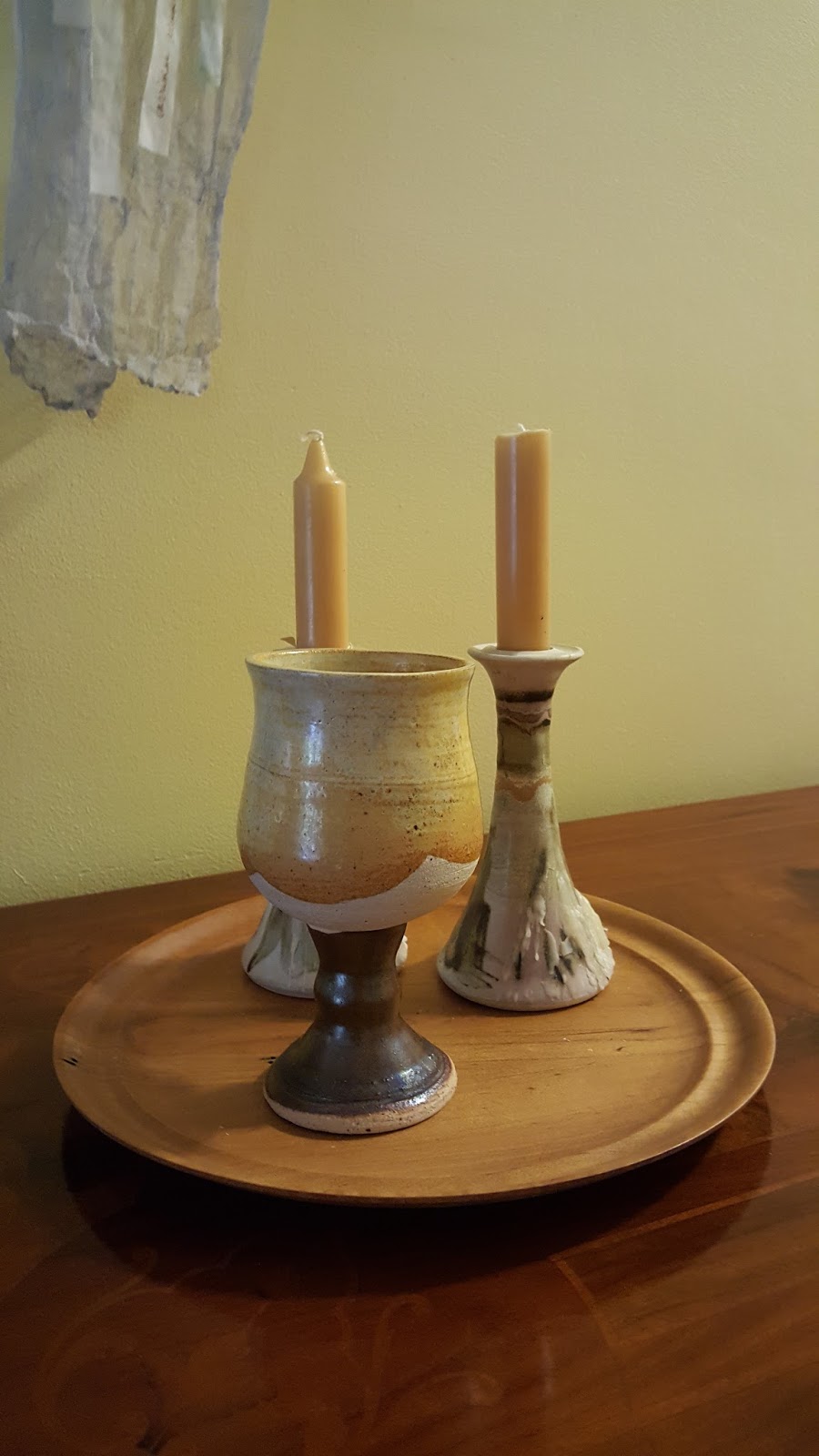
I was about to begin a new post, when I opened my mail to a message from a friend...in fact two messages from two dear friends, the best way I know to invite a new page and a new year.  One wished me peace; the other, wrapping her words in a calm, quiet (enviable) mood, inspired in me what she so perfectly called "the comfort in a familiar routine" that such holidays bring...breathing the aroma of apples and cinnamon while ironing table dressings and wiping wine glasses, looking forward to the songs of the ceremony, sung in her family's congregation by the cantor, "a tiny woman with a guitar".  She imagines that my dining room, like hers, will be where family will gather tonight.


Yes, the dining room will be our scene.  Instead of her apple cake, we will have rugelach, the nut-filled rounds with apricot. There will be ginger chicken, and potato gratin, and orange-carrot-fennel salad.  And apples and honey.

I hope to achieve as calm a space to prepare them as my friend has...my aunt will be out getting her hair done, and my uncle napping or reading, and the children not yet at the door.  I'll iron my tablecloth with some quiet music.

Years ago, I'd written a poem, Ironing on Shabbat, about that same calm achieved: the peaceful motion of the iron smoothing the cloth in a house "emptied of temple-goers", more religious than a formal ceremony.  Especially at a time when a little peace and quiet was a rare and most welcome gift for a young mother.


These days I've been making my own tablecloths and napkins by hand from fabric I find around on the remnant shelves; it's part of undoing a tangled day in the evening hours when I'm watching a movie or listening to music. Stitching without hurry, my hands can accomplish something for no required reason. There is sanctuary in the motion of the ordinary when calm prevails.
 
Even so, holidays like this one underscore the double edge we live with... as the table is plentiful and handsome with sweet things, so is the world outside (for too many, inside, too) full of terrors...want, war, megalomania, meanness.  We could drown in it if we didn't have these rituals which call us so firmly to our better selves.  Would that the whole planet knew how to untangle itself without pulling each other apart.


I too like the music of the service, for me the most spiritual part, like a mantle I wear for remembering.  Prayers for my children, for whom I keep it, the solemnity of halting the outside world to consider one's place in life, one's openness to peace...I do that for me.

With the friend who wished me peace today, I used, on the high holidays, to stay for the meditation service while most of the other congregants went home to nap til the memorial later in the afternoon.  We'd walk the gardens, or sit silently, or consider life awhile together.  Peace, acceptance...so little to ask of life and so precious, too often so far from reach.

And yet...may our tables shine with them, this night and always.


Tuesday, September 12, 2017

Storm Warnings

Ever since Ivan appeared on the scene, whirling out of the South Atlantic, I've been getting messages from family and friends by all sorts of media inquiring whether I've decided to evacuate.  The fact that the storm is nowhere near me, and, by at least some projections, not likely to do more than send a small tail of rain and wind our way, makes me wonder what use warnings of this sort, to the tune of the background noise of insistent newscasts, are.  And also makes me realize how little I pay attention to things like that.  For better or worse.


Not that I wouldn't move in a hurry if I lived in a Miami high rise and the storm was at my door, as it seems to be there today.  We have, in our time, sat out more hurricanes than I can count, and lived to tell the tale, but only after judicious consideration, or blind indifference.  Hurricanes shift what the weather people design as their "paths" all the time, so projections are little use to coast-dwellers, who, if they have been born and bred to the climate, know better than to expect the expected.  One takes shelter in different ways, depending on a lot of things both at home and in the sky.  My mother and aunts liked to tell a story of a day they spent in the kitchen at the shore, baking, when one of them looked out the side window and noticed that the ocean was running down the street only a few feet from the side lawn.  How a hurricane could sneak up on you like that is beyond belief, except that I, who was small and there with them at the time, must have inherited their cluelessness.  They stayed put, of course, put out candles, I suppose, and listened to the wind howl.  I don't remember hearing how the baking came out.

My husband and I, who had eighteen years earlier traveled through a raging hurricane to our new home near the sound, sat out Irene five or six years ago, along with all our neighbors, despite "mandatory" evacuation orders.  We weren't scofflaws; we lived in 100-plus year old houses and figured that they'd lasted this long without suffering defeat.  Irene too felt right at home and so stayed atop us all day and night until, in the morning, we all looked out at the fine day and fell to picking up the trees littering one another's yards.  Right now, one Floridian of my family has moved north; another, with ailing parents less able to make a trip, has hunkered down to ride it out.  A third southerner, like us nowhere near its path, has made elaborate plans to be somewhere else, where exactly he hasn't decided.  My friend talks about her friends who live in a double-wide in Irma's path, but can't decide whether to stay or find a last-minute motel.  There's nothing like hurricane warnings to show us our tendencies.


Meanwhile, other warnings ride the waves of the air.  I'm not sure I pay enough attention to those, either.  Along the way, things I should have had at least an inkling of have caught me by surprise, like that ocean hurling past my mother and aunt years ago.  A job cut.  A friend's betrayal.  And yet there are others I can feel in the wind right to my bones.  A child in danger (the worst of the worst).  A need to get away.

Close friends I'd planned to see today have had to cancel; his health won't permit the visit...he's at a dangerous crossroads, suddenly brought on, and his wife is on tenterhooks.  While the cancellation is understandable, it's thrown me off this morning in surprising ways.  Coming home from the aborted trip, I changed and began to think of what I could get done instead...there's quite a list...but somehow I couldn't organize myself to what are, after all, pretty simple tasks.  I really wanted to see my friends.

I put on a recording of some Cajun music I like (my friends are from New Orleans in the most entrenched way) and thought about making shrimp remoulade for dinner.  To the tunes of the Breaux Brothers, I began to make some cookies, then went out in the yard to prune the overindulged tentacles of what's known in these parts as ugly-agnus.  The cookies crumbled; the pruning, which I usually consider therapeutic, seemed tedious.  Coming back into the house, I tried a few phone calls, but the work I really have to get done...art I've long neglected (and me with a November show coming up!)...just wasn't in me.   I'm thinking of my friend, blank of mind about his condition, and knowing I probably won't know how he is until much later.  That seems to have drained me of any focus except on him and on his wife, whose voice on the phone was uncharacteristically heavy with portent.  It's difficult to be so far away from those I care about and want to support.

I used to like storms...still in a way, do...but so much experience with those inner ones life throws at us have warn me down.  I believe I'm good at coping with what comes, but these days I think to myself, what next?, and not in a cheerfully anticipatory way.


I'd say that I'm just temporarily out of sorts (I used to tell my husband that, to his puzzlement; "What does that mean?" he'd ask), except that outside it's a beautiful day, one of the nicest we've had in a week of gorgeous weather, and one of my favorite seasons, fall, is in the air, and I've a workshop full of potential just waiting to be realized.  There is every reason to be hopeful, to be full of life, to be engaged in the future.

Instead, all I seem to be able to do is shrug, and wait for it to pass, hoping whatever storm is roiling through me leaves me grateful for the rain, inspired again, and, most important, facing no great loss.  Evacuation isn't really possible in such circumstances; neither is gathering candles and stockpiling peanut butter and water.  We just have to ride it out and accept the yard full of broken trees.  If the dam breaks, it breaks, and we ride its muddy wash out until our feet touch land again.  Then we get up again and start over.
___________________________________________________________


A few days later, we're still waiting for rain stronger than a drizzle, but the weather has cooled a bit, and to counteract the gathering clouds I decided that I'd use up a week's leftovers by making a meal (I'd give anything to share it with my ailing friend) that seems to warm everyone.  Those of you in the same boat might try it, too:

Pot Pie
1. Dice leftover (cooked) chicken and set aside.  If it's been dressed while it was cooked...for example with pesto or balsamic reduction or even BBQ sauce...so much the better for flavor.
2. Saute some onion, celery and carrot, also diced, until the onion is almost translucent.
3. Add the chicken dice, about a cup of vegetable broth mixed with a small can of evaporated milk, and some parsley, sage, and thyme.
4. Add some small-diced sweet potato or butternut squash (or both) and cook for a few minutes, 
then add some green peas and cut string beans, maybe some corn kernels, asparagus, sauteed mushrooms, whatever.  Season with S/P (red pepper is best).
Either:
5a. Mash some potatoes with butter.
or
5b. Make a short pastry and roll out to about 1/4 inch thickness.
or
5c. Mix up some cornbread batter.
6.  Pour the chicken mixture into your prettiest casserole dish and top with the mashed potatoes (5a.) or the pastry (5b.) or the cornbread batter (5c.)  
If you use the mashed potatoes or the cornbread batter, just mound it here and there over the top.  If you use the pastry, cut out a pretty design to vent the steam.
7.  Bake at 350 degrees for 45 minutes while the house warms and smells delicious.
If, like me, you don't do meat, just substitute all the vegetables you can think of for the chicken.  If you're vegan, lose the butter and milk.  Won't make any difference to comfort.
If your refrigerator goes out during the storm, you can reheat it on your outdoor grill, 
or share it lukewarm right out of the pot.
A bottle of your favorite wine, red or white, isn't a bad idea, either.


Tuesday, March 14, 2017

One of Those Days

In the film The Best Marigold Hotel, one of the characters, a high court judge in London, drags himself along to a retirement party for a colleague.  One day soon he will be next, he grumps to a fellow judge, who reminds him that he's heard that before.  But no sooner does he enter the room than a shock to the heart overtakes him, and he backs away through the crowd.  "This is the day," he announces to the crowd at large.  "This is the day."

This is the day for me, as well...not to retire (supposedly I did that a decade ago) but to get on with a journey I have been, like the judge, threatening (here read hoping) to make for some time.  Sometimes it doesn't even take a TIA to know when the time comes.


So, I thought a few weeks ago, it's time I went to Paris.  Really time.  I wondered what I'd been waiting for, though the answer came quickly enough.  But a look at the calendar and a bit of foresight into the future told me that what is usually a scarce commodity around here...time...had broken open its tightly held trove and offered me a gift.  I grabbed it, running to make a plane reservation, then a week later, more pensively, to find a place to stay.  Friends in London, when I told them, signed on for part of my journey, so I will be stopping there on the way so that we can take the Eurostar together to the City of Light.

Mon vieil ami d'ecole, Will and, we are hoping, Dorothy will spend a few days visiting friends there and, if I know (and trust) Will, walking me around the city recounting les histoires des toutes des pierres dans les boulevards and les rues.  Having spent a goodly number of years taking students on the best European tours of their lives (he's known as a legend in the trade of studies abroad), he has learned a thing or two about le terrain, but, more important, he remembers everything.  His mind, like that of his old mentor (whom I fortunately later married), un professeur extraordinaire, is a veritable trap of data, history, and tales with a fine sense of life and humor.


I still remember our trip through London nine years ago, especially along the Thames in Southwark, Shakespeare's old haunts. Then I was traveling with both of them, trailing along while they traded dissertations on everything from Renaissance theater to the Clink and its attendant streetwalkers.


For many reasons, seeing Paris first with Will along for the ride makes me smile just thinking of l'aventure a venir.

[Pardonnez moi, all you French majors and maitres:  I can't figure out how to make cedillas and accents, neither grave nor acute, not to mention carets, on this site...but s'il vous plait, just assume there is a chance I know they should be there...like that one in plait...]


Which aside brings me to the time spent since I made that last reservation...learning, encore, all the French I have forgotten since school.  I know...it's pretty much a cliche', dredging up high school language lessons from fifty years ago.  I won't know how I've done til I get there, of course, but so far so good.  As long as I am speaking or reading simple subjects and verbs, I'm sure I'll be fine.  But the French films I've been watching nearly every night, just so I can listen to la langue real, have taught me another lesson.  Aside from picking up the occasional idiom, when I shut off the subtitles I'm able to recognize only a word or two every sentence or two.  Quel dommage.  


Fortunately, there are great contemporary books about all sorts of aspects of Paris, all of which I have been absorbing like a sponge. Along with the requisite guide book, I think I will tuck David Lebowitz's The Sweet Life in Paris and Adam Gopnik's Paris to the Moon in my travel bag to relive once my feet are on their ground.

Alors, on continue d'apprendre.  I've still got another week.  Wish me bonne chance!
__________________________________________________________

At this moment, more interesting than French grammar, there are fifty or more robins in my ailanthus bushes, a female cardinal among them.  They're fluttering wildly through the neighbors' ailanthus, too, feasting on the berries with which for a short time spring decorates those otherwise unremarkable plantings.  Ailanthus are way too prolific here, because they'll grow whether you care for them or not, and so everyone's predecessor put them in among the trees and rocks to fill in, knowing they keep their leaves all year whatever the weather.


For that reason they're a lesson in the reliability of sturdiness over the all too short summer's lease, and fill the yard with wandering tendrils (growing as long as you will allow them to lengthen) when all else fails.  But like me the robins are taking advantage of the moment and have set themselves to pick clean the red pearls that are the ailanthus' fleeting glory.  I can't blame them,  We are in the tail of the great northeastern storm that is bringing our temperatures into the twenties tonight, despite the fact that we have had weeks of sixty and seventy degrees, spoiling us for spring.  Fortunately it's only some spurts of high winds, helping to prune the dead branches from the trees and giving the sun a little run for its money.  We dig our scarves and gloves out of storage and carry on.

Besides, there's Paris to look forward to.

___________________________________________________________ 

Wait!  Don't close that page yet...


This weekend (March 17-18), the 7th Pamlico Writers Conference opens in Washington, North Carolina.  On the program Saturday afternoon will be my session on Journals as the Ultimate Sourcebook for writers. Both my workshop and the whole conference are open to anyone interested in writing or writers of any level. Join us if you can.  You can enroll at the door, or on their website.  For more information, go to https://pamlicowritersgroup.wildapricot.org/event-2260134.


Saturday, November 5, 2016


Cathy and I invite you to our 
Open Studio
for Art, Tea and Treats
just in time for the Holidays!

November 12 and 19   *   10 - 4  

                           901 Roosevelt Drive, Chapel Hill
Come see what treasures you can find for Gifts
(and a little Self-Indulgence, too).


Wednesday, November 2, 2016

Philly, or Travels against the Wind


A few weeks ago, rounding the corner of Hurricane Matthew, I flew to Aruba with the children for their family vacation.  I'd held as my beacon for a long time a trip to Paris I've been saving up for in early spring, so at first, when they asked me, I waffled a bit, thinking about the lure of cafes and walks through elegant parks on my own time.  I'm not good with resorts ("That's a great first line for a story," Jill McCorkle joked when I told her about it). But I did want to spend relaxing time with them, and I'd never been anywhere in the Caribbean.

So off we went, and the pilot, though he'd warned us apologetically of a bumpy trip, made in fact a pretty smooth affair of it, gliding around the storm, costing us barely an hour and saving the journey from Miami to Orangestad.

 Aruba is a small island, only about 20 miles long and barely 6 miles across, nearer to Venezuela than anywhere else, but it was a Dutch possession for so long (with farther back Spanish influences and even farther back Amer-Indian) that one's impressions of it are shaped by the fantastic architecture, smooth-faced low buildings with the curled accents of European inhabitants, but in bright island colors.  At least, those are what built the original towns--the capitol's back streets, Santa Cruz, Savaneta, San Nicolas among them.  You could hear its roots tangled in its language.

On the other hand, the resort area of Palm Beach, where we stayed, is another story, pretty much indistinguishable from those photos cluttering websites and print ads of beach resorts everywhere...high white hotels with uniformed guards (the more expensive the place, the more they frowned at passing intruders), miles of blue lounge chairs facing the sea, low pools whose central gathering place is the floating bar.  And on the streets behind them, fancy shopping of the kind found anywhere from Fifth Avenue to Nice to the great mall at Tel Aviv.

Because of Matthew, the famous white sands were, when we first arrived, gray with rotting seagrass and pieces of sponge and coral, and the equally famous seas, known for their clear blue-green jewel tones, were dulled (Aruba isn't hit with hurricanes directly, but does receive the resulting ocean debris nonetheless).  Hotel staff spent all day trying to rake and cart away the mess, but it took them most of the week, and only on the last day were we able to enjoy its return to the advertised normal.  On that day, we floated and dived under the morning's bright sun, watching the fish school in and out around our legs. Ah.


What I wanted most to do every day was walk on the beach, but debris and the jutting hotels made that difficult to do for more than half a mile or so.  Instead, we built rock forts and walls with Alexander, lounged around the pool while he splashed with other children from everywhere (resorts are wonderful for the younger set), and in the hot afternoons, took drives to the outer limits of the island.


For me, those drives were the highlight of the trip to Aruba.  We saw the brochure-touted landmarks, yes--brilliant white lighthouse, tiny precious chapel, the beautifully, perfectly restored historic museum and the Fort downtown where there was an intriguing textiles exhibit, both historic and contemporary.


But we also saw the everyday island.  That's what interests me about a place.
Along the roads, there were coves that dipped protectively in and out of sparsely inhabited shores, cottages with porches where people gathered after work, larger estates, once the neighborhoods of the all-but-defunct oil industry, now barred and mostly for sale, the corner bodegas and grocers, dogs and children roaming street to street, a neighborhood fair where green-iced homemade cakes and Dutch fried breads competed for tasters and music filled each street-end.  Out even farther, in the desert that covers a good deal of the island, fields of tall cactus, thick as forests in some places, formed mileposts.


Aruba's best art is as much her artless countryside as it is her artists' native expressions.  I was inspired by both.


One afternoon, we drove out up the narrowest of roads, bumped every few feet by rocky drainage spurs, and found ourselves at the Quadirikiri caves, black and pitted from the spray of the nearby sea, storm-spurred, crashing against the bulwark of cliffs.  We walked down toward an abandoned house wide open to the elements (it could be yours for a single year's underpaid academic salary, and then two more years' overpaid salary to make it habitable again) and found there the remnants of two gardens, a flowing creek pooling under a canopy of graceful limbs, and, inside, the once beautiful floors still tiled coolly against the heat.  I imagine a life there, at the edge of the world, just the right size house, nearly self-sufficient (though supplies would be a long long trek, or helicopter delivery, each month), the bones of the desert white in the moonlight, the hardscrabble ground blinding day, and this calm outpost the shelter of the mind.


Travel, even the kind one waffles over, brings such surprises, such visions, and, eventually, such art.  Like houses, being shown the parlor isn't seeing what's really a home. I think of the stereotype of the place I imagined, and how, though some of my reasons for it turned out to be true, there is always a reality worth realizing, a life beneath the mask tourism paints on a country.


And by the way, if you are puzzling over the title of this piece, you'll have to wait until next time to realize that one.  When I started out, I meant to write my more recent trip last week to the City of Brotherly Love, using Aruba as only a short preface, but this is what writing is like, isn't it?  You never know where it's going to take you. So consider this Voyage I, and Voyage II (the Real Philly) to come walking in just after it.  And walk we did.

Wednesday, September 14, 2016

Cinnamon

Tuesday, September 06, 2016

Though the temperature reads almost 90 this afternoon, there’s a real difference in the air that smells like Fall.  This morning’s early walk around my neighborhood circles was cool and light, the sun just coming up above the rooflines.  And I’ve still got the doors open with a breeze floating through now and then.
Cathy Burnham, copper bracelet

In the studio, at work painting some cards for Holiday with Friends , the November Open Studio I’m doing here at Rachel’s House with my neighbor and talented jeweler, Cathy Burnham, I noticed that the color most enticing me was a dab of yellow, with crimson and ochre.  Together, they’re cinnamon.  Soon the center of my palette was an effusive variety of that spicy mix. "Fall Garden",the first miniature painting, which is really what my one-of-a-kind cards are, seemed to shine with it, even on the flower petals.  

I remembered that  Asheville Bookworks  has a two-day workshop which includes using rust to stain paper (sign me up!).  The model bookcovers on the webpage looked so rich you could eat them. And later, I picked up a piece of Cathy’s leftover copper, thinking about what I could do with it in a hanging.

So, cinnamon is everywhere today.  And no wonder.  Down in the kitchen, rice pudding was baking (my mother’s recipe, low temperature, stirred often) with plenty of that spice in it.  The whole house smelled of it for hours.  And outside, given our mostly rain-less month so far, the landscape itself is turning toward those earthy shades.

It’s interesting the way nature finds its theme no matter which of the senses we’re using to take it in.  Oh, there’s plenty of green left, and the reign of purple blooms—Liriope, verbena, bee balm to the fore, typical of late summer—isn’t abdicating yet, but across the street, Jean-Marie and Maureen’s dogwood has been shedding leaves more fit for a carnival than for early September in these parts.  The breeze brings an invigoration that calls us outdoors, or at least calls the outdoors in.  It pushes us farther into the season than the calendar allows.  On the front door, I've hung a ring  that brings October to mind.  Something in the air makes me disdain sunflowers in favor of nutty, leafy arrangements, and in my studio leaves and branches fall out of the paint onto paper, instinctively knowing it's their season, no matter what the calendar says.


Mom's Creamy Rice Pudding
1/3 cup rice, uncooked
4 cups milk
1/4 cup sugar
1/2 tsp salt
1/2 tsp cinnamon (heaping)

1/2 cup raisins

Wash rice thoroughly and drain.  Grease a medium glass baking dish.  Mix rice with remaining ingredients and pour into baking dish.  Bake in a slow oven (325 degrees F.) about two hours, stirring often during baking until the last fifteen minutes.  The mixture should never boil.  Serve hot or cold.                                                                                                                                                              from A Family Cookbook